Defending Web APIs Against the OWASP Top 10: Secret Vaulting, Token Exhaustion, and Broken Access Control
API attacks have surpassed traditional web vulnerabilities as the primary attack vector against modern web applications. From preventing hardcoded secrets with pre-commit git hooks to token-bucket rate limiting and enforcing object-level authorization across every SQL query, here is how to harden your API layer.
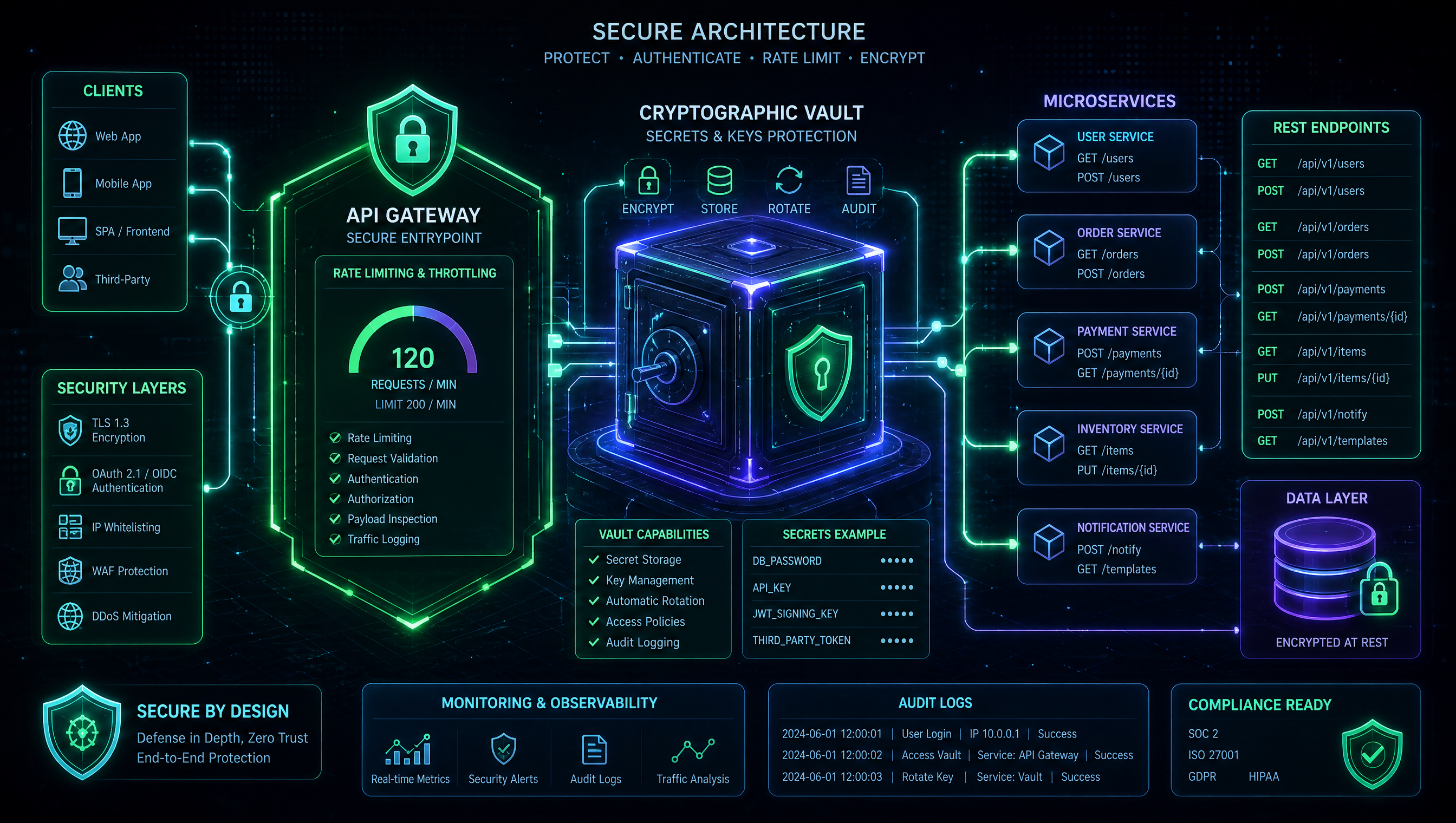
Table of ContentsExpand
Defending modern web APIs against the OWASP API Security Top 10 requires defense-in-depth across three architectural planes: (1) identity gates enforcing strict Broken Object Level Authorization (BOLA) checks verifying tenant ownership on every resource ID before executing database reads or mutations, (2) ingress rate-limiting using distributed token-bucket algorithms (Redis/Cloudflare) to prevent brute-force token exhaustion and scraping, and (3) automated zero-trust credential hygiene utilizing pre-commit secret scanners (TruffleHog) and cloud secret vaults (Doppler/AWS Secrets Manager) to mathematically eliminate hardcoded API keys.
- 01.Never trust client-supplied resource IDs: always filter database queries by both resource ID and authenticated user tenant context.
- 02.Enforce distributed rate limiting at the edge reverse proxy using sliding window counters to throttle abusive endpoints before hitting application compute.
- 03.Implement automated pre-commit and CI/CD secret scanning to block leaked API tokens, private keys, and database URIs before git push.
- 04.Sign and verify all incoming webhooks using HMAC SHA-256 with timing-safe string comparison to defeat timing attacks.
- 05.Validate every incoming JSON request body against strict TypeScript/Zod schemas, immediately rejecting unexpected fields.
| Vulnerability Vector | Naive API Architecture | HarLyn Zero-Trust Hardened Standard |
|---|---|---|
| Object Authorization (BOLA) | Queries database directly by client-supplied ID: SELECT * WHERE id = :id | Always binds authenticated tenant ID: SELECT * WHERE id = :id AND tenant_id = :tenantId |
| Credential Management | API secrets committed to git repositories or plaintext .env files | Automated pre-commit scanning with centralized secret vaulting |
| Traffic Throttling | No rate limits; vulnerable to brute-force and DDoS exhaustion | Distributed sliding-window token bucket throttles bad actors at the edge |
| Payload Sanitization | Blind trust in JSON body; prone to mass assignment vulnerabilities | Strict schema validation rejecting unauthorized fields with HTTP 422 |
The Rise of API-First Attack Vectors
As architectures migrate from server-rendered monoliths to microservices, single-page applications, and mobile clients, the API has become the primary target for malicious reconnaissance and data breaches.
According to global cybersecurity research, over 70% of web security incidents now exploit API logic flaws rather than classic network buffer overflows. Attackers do not need complex zero-days; they simply exploit missing authorization checks, scraped credentials, and rate-unlimited endpoints.
Here is how we eliminate the most critical OWASP API vulnerabilities at HarLyn.
Layer 01: Eliminating BOLA with Contextual Predicates
Broken Object Level Authorization (API1:2023) remains the number one threat in web application security.
Consider a vulnerable endpoint:
GET /api/orders/8492 HTTP/1.1
Authorization: Bearer <valid_jwt_for_user_A>
If user A changes the URL to /api/orders/8493 and the backend executes:
-- VULNERABLE TO BOLA: Only checks record existence, not tenant ownership
SELECT * FROM orders WHERE id = 8493;
User A now views User B's private invoice, order history, and home address.
The Defensive SQL Pattern
Never allow a query to fetch an object by primary key alone without scoping it to the authenticated tenant:
-- SECURE: Mathematically bound to the authenticated user's organization
SELECT * FROM orders
WHERE id = :orderId
  AND (tenant_id = :authTenantId OR user_id = :authUserId);
If the query returns zero rows, return a generic 404 Not Found rather than a 403 Forbidden to prevent attackers from discovering whether the ID exists.
Layer 02: Secret Vaulting & Pre-Commit Scanning
Hardcoded API keys (OpenAI keys, Stripe secrets, Supabase service roles) committed to git repositories are scraped by automated botnets within less than two minutes of being pushed to public or even private repos.
1. Enforce Pre-Commit Git Hooks
Install pre-commit secret screening in your development workflow:
# Install TruffleHog git hook
trufflehog git file://. --since-commit HEAD --only-verified --fail
2. Isolate Environment Secrets in Encrypted Vaults
Never email or Slack .env files between team members. Store production secrets in centralized vaults like Doppler or AWS Secrets Manager, injecting secrets at runtime directly into process memory.
Layer 03: Distributed Token-Bucket Rate Limiting
Without rate limiting, malicious actors can brute-force 2FA codes, enumerate sequential customer records, or exhaust costly LLM tokens.
Implement a sliding-window token bucket using Redis:
import { Redis } from "@upstash/redis";

const redis = Redis.fromEnv();

export async function rateLimit(ip: string, limit: number = 60, windowSeconds: number = 60) {
  const key = `rate_limit:${ip}`;
  const current = await redis.incr(key);

  if (current === 1) {
    await redis.expire(key, windowSeconds);
  }

  return {
    success: current <= limit,
    remaining: Math.max(0, limit - current),
    reset: windowSeconds
  };
}
Attach this middleware to sensitive routes—such as authentication endpoints, checkout webhooks, and AI reasoning streams—returning HTTP 429 Too Many Requests when thresholds are breached.
Layer 04: Timing-Safe Webhook Signature Verification
When receiving webhooks from payment gateways or external partners, always verify the cryptographic HMAC signature using constant-time equality verification:
import crypto from "crypto";

export function verifyWebhookSignature(
  rawPayload: string,
  signatureHeader: string,
  secret: string
): boolean {
  const computedSignature = crypto
    .createHmac("sha256", secret)
    .update(rawPayload, "utf8")
    .digest("hex");

  const expectedBuffer = Buffer.from(computedSignature, "utf8");
  const providedBuffer = Buffer.from(signatureHeader, "utf8");

  if (expectedBuffer.length !== providedBuffer.length) {
    return false;
  }

  // Timing-safe comparison to prevent character-by-character timing attacks
  return crypto.timingSafeEqual(expectedBuffer, providedBuffer);
}
The HarLyn Standard
All web systems we build or audit undergo rigorous OWASP API penetration testing to guarantee zero credential leakage and impenetrable authorization gates.
Frequently Asked Questions
Bring This Resilience to Your Enterprise Stack
Harrison Ndeke and Nazline Mwita conduct a comprehensive 48-hour diagnostic audit of your n8n workflows, Next.js web application speed, and cybersecurity perimeter.