Deterministic AI Agents: Why State Machines Beat Autonomous Swarms in Production
Most teams building multi-agent systems make the same mistake: creating unconstrained group chats. Here is why autonomous swarms fail in enterprise production and how to architect deterministic state graphs with schema-validated tool contracts.
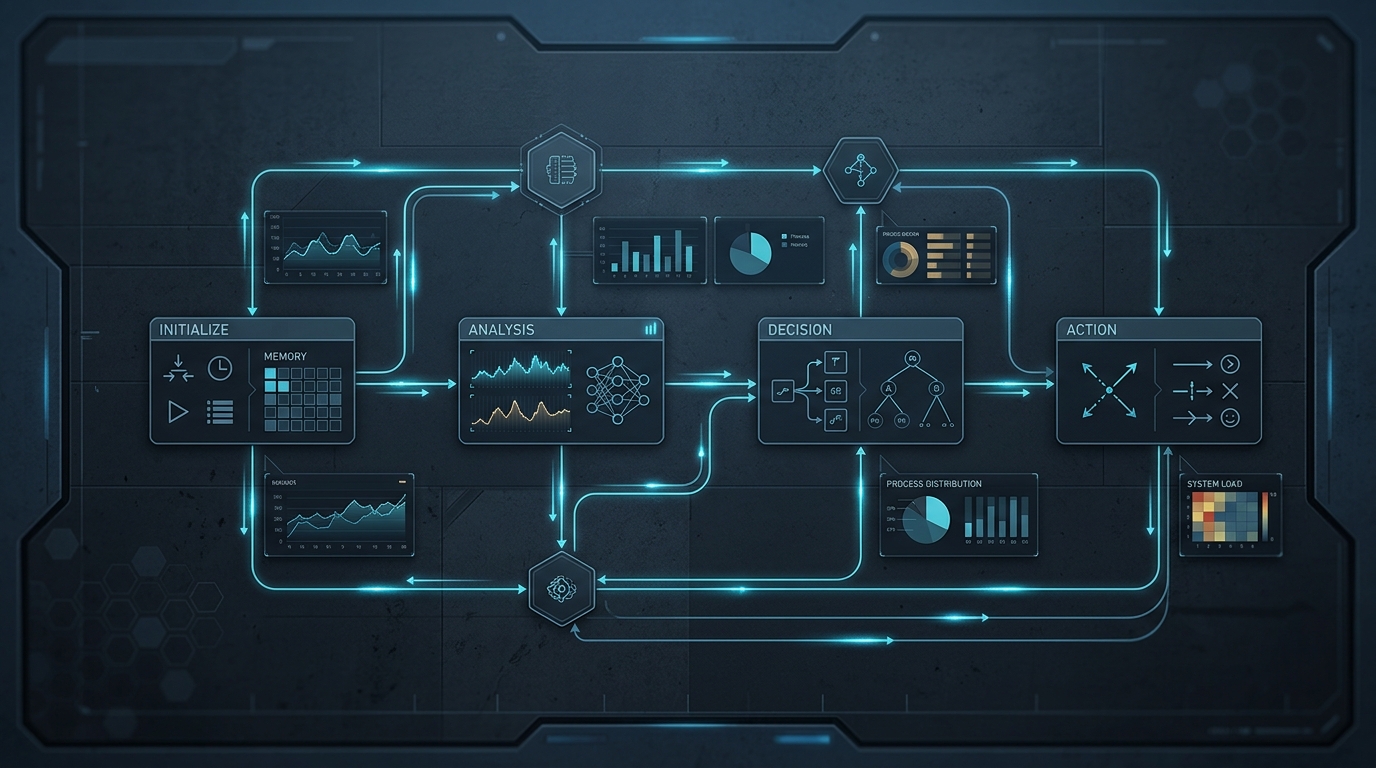
Table of ContentsExpand
Deterministic AI agents replace unconstrained group-chat swarms with hardcoded Finite State Machines (FSMs) and Pydantic schema contracts. By restricting LLMs to specialized task execution within bounded step budgets while delegating routing to deterministic state transitions, engineering teams eliminate runaway token loops, cascading hallucinations, and non-deterministic state corruption.
- 01.Unconstrained multi-agent swarms fail in enterprise production due to O(N^2) token burn and unverified conversational loops.
- 02.Production agent architectures separate routing logic (deterministic code FSM) from execution logic (specialized LLM tool nodes).
- 03.Inter-agent messaging must be strictly validated via Pydantic or Zod schemas rather than free-form markdown text.
- 04.Context windows must remain ephemeral and isolated per node to prevent corrupt memory propagation.
- 05.Every execution branch requires hard step budgets and circuit breakers to prevent infinite retry deadlocks.
| Architectural Vector | Unconstrained Swarm (Twitter Demo) | Deterministic FSM (HarLyn Standard) |
|---|---|---|
| Routing Logic | Improvised by LLM group chat | Hardcoded deterministic state machine |
| Inter-Node Data | Unstructured natural language markdown | Typed Pydantic / Zod schema contracts |
| Context Isolation | Shared global conversational thread | Ephemeral sandboxed micro-context per node |
| Failure Recovery | Infinite conversational hallucination loop | Bounded retry ceiling with automated fallback node |
The Production Agent Reality Check
In 2024–2025, prototype demos convinced thousands of developers that building autonomous multi-agent systems meant dumping 5 agents into a shared conversational loop and hoping emergent intelligence solved complex tasks.
In production environments, unconstrained agent swarms fail consistently. They suffer from three fundamental architectural flaws:
- O(N^2) Context Explosion: Every conversational turn between Agent A and Agent B multiplies the token payload sent to downstream agents, rapidly exhausting rate limits and blowing up API costs.
- Cascading Hallucination Propagation: If Subagent A extracts an inaccurate parameter or invents an API contract, Subagent B treats that fabricated claim as ground truth and executes destructive mutations.
- Non-Deterministic State Divergence: Executing the identical workflow twice against the same data generates completely distinct outcomes, rendering system debugging, automated regression testing, and SLA guarantees impossible.
┌────────────────────────────────────────────────────────────────────────┐
│                   DETERMINISTIC FSM AGENT GRAPH                        │
├────────────────────────────────────────────────────────────────────────┤
│ [Start] ──► [Plan Node] ──► {Schema Gate} ──► [Execute Tool Node]      │
│                                  │                                     │
│                         (Invalid Contract)                             │
│                                  ▼                                     │
│                     [Deterministic Retry Limit]                        │
└────────────────────────────────────────────────────────────────────────┘
The 4-Tier Deterministic Framework
To deploy agentic workflows that achieve 99.9% task reliability, engineering teams must separate Routing Logic from Execution Logic.
1. Hardcoded Finite State Machine (FSM) Orchestrator
The global workflow is modeled as an explicit state graph (e.g. Ingest ➔ Plan ➔ Execute ➔ Verify ➔ Synthesize). Transitions between states occur exclusively when strict mathematical invariants or deterministic assertions pass.
from enum import Enum
from pydantic import BaseModel, Field

class AgentState(str, Enum):
    INITIALIZED = "INITIALIZED"
    PLAN_GENERATED = "PLAN_GENERATED"
    TOOLS_EXECUTED = "TOOLS_EXECUTED"
    VALIDATED = "VALIDATED"
    FAILED = "FAILED"

class StepTelemetry(BaseModel):
    current_state: AgentState
    step_budget_remaining: int = Field(default=5, ge=0)
    retry_count: int = Field(default=0, le=3)
    error_log: list[str] = []
2. Pydantic-Enforced Inter-Agent Contracts
Subagents must never communicate using natural language markdown. Every inter-node message is serialized through strict Pydantic schemas. If an agent returns JSON missing a required key or typing violation, the parser triggers an isolated self-healing loop.
3. Isolated Context Sandboxing
Global context sharing across nodes is an anti-pattern. Each subagent runs in an ephemeral context window containing solely the system instructions for its micro-task and the exact input artifact.
4. Hard Step Budgets & Circuit Breakers
Every execution branch enforces bounded step budgets, execution timeouts, and cost ceilings. If an agent loops more than 3 times without progress, the circuit breaker trips and graceful degradation activates.
Frequently Asked Questions
Bring This Resilience to Your Enterprise Stack
Harrison Ndeke and Nazline Mwita conduct a comprehensive 48-hour diagnostic audit of your n8n workflows, Next.js web application speed, and cybersecurity perimeter.