Real-Time Network Threat Hunting: How Machine Learning (NIDS) Classifies Malicious Traffic Flows Before Breaches Occur
Static firewall rules and signature-based IDSs like Snort or Suricata fail against polymorphic threats and encrypted botnet channels. By extracting flow-level statistical metrics with NFStream and Scapy and classifying them with trained XGBoost models, modern SOC teams achieve sub-10ms threat detection with 98%+ accuracy.
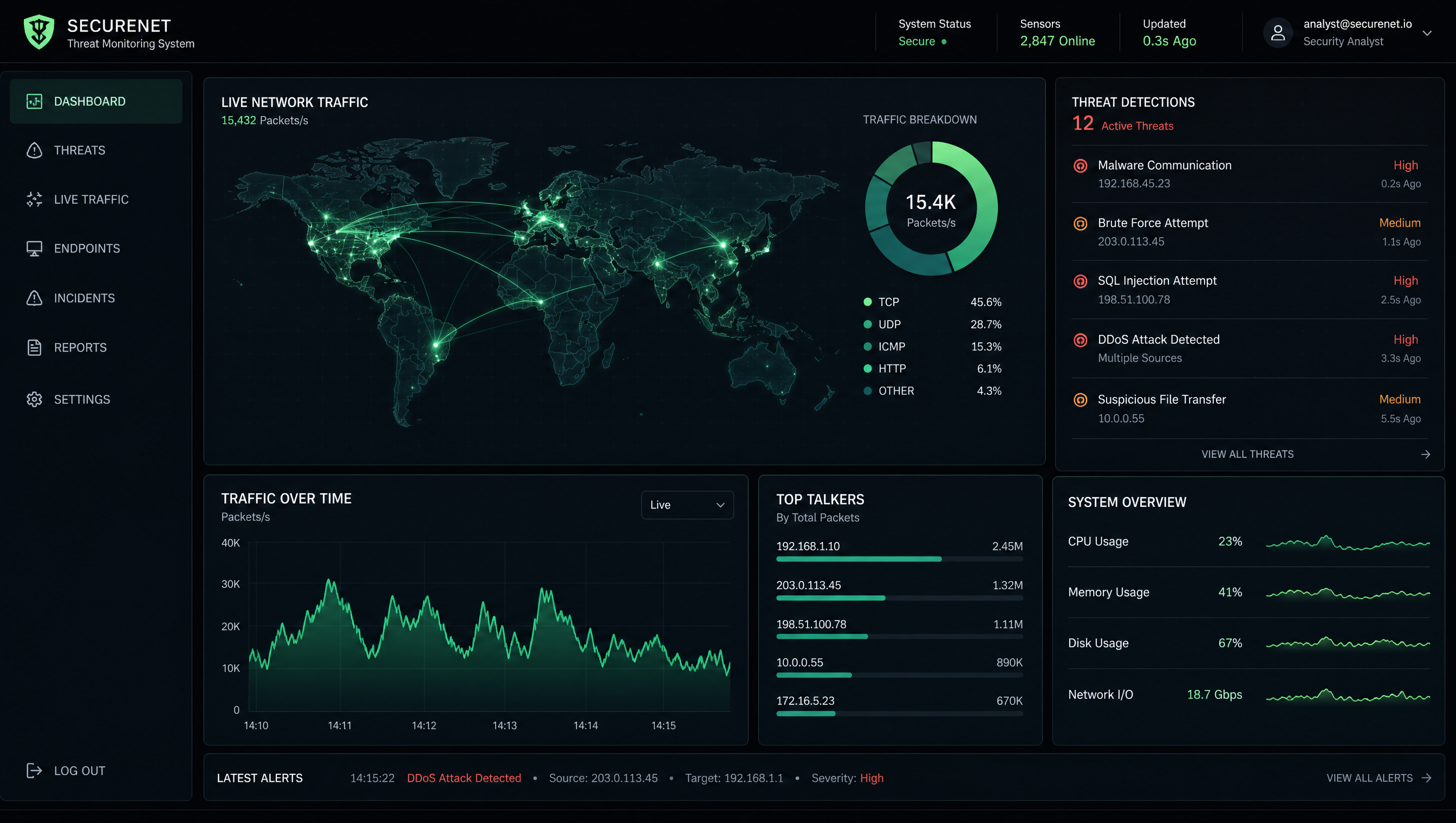
Table of ContentsExpand
Machine-learning Network Intrusion Detection Systems (NIDS) surpass traditional signature matching by analyzing behavioral flow dynamics rather than static packet payloads. By computing statistical features—including flow duration, packet inter-arrival variance, flag ratios, and forward/backward byte distributions—algorithms such as XGBoost detect zero-day exploits, port scanning, and volumetric anomalies with sub-10ms inference latency, even when traffic payloads are fully encrypted with TLS 1.3.
- 01.Signature-based detection fails on zero-day exploits; behavioral flow classification identifies attack topology regardless of payload mutation.
- 02.Extract bi-directional flow features (duration, packet size kurtosis, IAT variance) using high-throughput network parsers like NFStream and Scapy.
- 03.XGBoost consistently outperforms deep neural networks for tabular flow telemetry in production due to microsecond inference latency and explainable SHAP feature importance.
- 04.Integrate real-time NIDS classification directly into automated firewall ban-rules via edge API webhooks to isolate malicious IPs dynamically.
- 05.Benchmark detection models on standardized multi-class datasets (such as UNSW-NB15) to evaluate false positive trade-offs.
| Detection Vector | Legacy Signature IDS (Snort/Suricata) | HarLyn ML Flow Classifier (NIDS) |
|---|---|---|
| Encrypted Traffic | Completely blind unless high-latency TLS decryption is deployed | Analyzes metadata, packet sizes, and flow timing with zero decryption |
| Zero-Day Exploits | Fails completely until security vendors publish new CVE signatures | Detects structural and volumetric anomalies based on behavioral models |
| Inference Latency | Matches packet strings against tens of thousands of regex rules | Sub-10ms tree traversal via trained gradient boosted trees (XGBoost) |
| False Positive Tuning | High manual rule fatigue; alerts ignored by overwhelmed operators | Calibrated confidence scoring with SHAP feature explainability |
The Breakdown of Signature-Based Firewalls
For decades, enterprise network security relied upon signature-based intrusion detection systems (IDS) such as Snort or Suricata. These systems operate by scanning packet payloads against vast databases of known attack strings and regular expressions.
In 2026, this paradigm has broken down for two fundamental reasons:
- Ubiquitous Encryption: Over 95% of web and API traffic is encrypted via TLS 1.3. Signature matchers cannot read inside encrypted tunnels without deploying complex, high-latency TLS termination proxies that compromise end-to-end privacy.
- Polymorphic Payloads: Attackers continuously alter bytecode, use randomized obfuscation, or weaponize zero-day exploits that possess no preexisting signature.
To defend modern infrastructure, we must inspect behavioral dynamics rather than static strings.
Architecture 01: Statistical Flow Extraction
A single network packet tells you very little. A bi-directional network flow—the series of packets exchanged between an IP/port pair over time—tells you everything.
Using high-throughput C/Python engines like NFStream and Scapy, we ingest raw network interfaces (or PCAP files) and aggregate packets into structured statistical vectors:
# lib/nids/flow_extractor.py
from nfstream import NFStreamer

def extract_flow_features(interface_name: str):
    # Stream live packets with active bidirectional flow aggregation
    streamer = NFStreamer(
        source=interface_name,
        statistical_analysis=True,
        idle_timeout=15, # 15s idle timeout to close flow
        active_timeout=120
    )

    for flow in streamer:
        # Extract features for XGBoost model input
        features = {
            "dur": flow.bidirectional_duration_ms,
            "sbytes": flow.src2dst_bytes,
            "dbytes": flow.dst2src_bytes,
            "sttl": flow.src2dst_mean_ttl,
            "dttl": flow.dst2src_mean_ttl,
            "sload": flow.src2dst_bps,
            "dload": flow.dst2src_bps,
            "spkts": flow.src2dst_packets,
            "dpkts": flow.dst2src_packets,
            "synack": flow.bidirectional_syn_ack_ms,
            "tcprtt": flow.bidirectional_tcp_rtt_ms
        }
        yield flow.src_ip, flow.dst_ip, features
Architecture 02: Real-Time Flow Classification
Once features are extracted into a numerical vector, we pass them into a pre-trained, calibrated XGBoost Classifier.
Unlike cumbersome deep learning architectures that require heavy GPU infrastructure, XGBoost runs directly on CPU edge instances, producing binary (Benign vs Malicious) and multi-class (Fuzzers, Analysis, Backdoors, DoS, Reconnaissance) predictions in under 2 milliseconds:
# lib/nids/classifier.py
import joblib
import numpy as np

class ThreatClassifier:
    def __init__(self, model_path: str):
        self.model = joblib.load(model_path)
        self.classes = ["Normal", "Generic", "Exploits", "Fuzzers", "DoS", "Reconnaissance"]

    def predict_threat(self, feature_dict: dict):
        # Convert dictionary to ordered feature vector
        vector = np.array([list(feature_dict.values())]).reshape(1, -1)

        # Predict probability distribution
        probabilities = self.model.predict_proba(vector)[0]
        max_idx = np.argmax(probabilities)
        confidence = probabilities[max_idx]

        return {
            "is_malicious": max_idx != 0,
            "threat_category": self.classes[max_idx],
            "confidence_score": float(confidence)
        }
Architecture 03: Automated Threat Quarantine
Detection without automated mitigation is useless when attacks unfold at gigabit speeds. When the classifier reports a confidence score exceeding 0.92:
- The classification engine triggers an internal webhook.
- The webhook instructs the edge firewall (Cloudflare API or Linux
nftables) to insert a temporary drop rule for the offending source IP. - A telemetry snapshot—including SHAP feature contributions explaining *why* the model made the classification—is written to the SOC alert queue.
Case Evidence: UNSW-NB15 Benchmarking
This architecture powers the AI Integrated Smart Packet Analyzer developed by Nazline Mwita. Benchmarked against 82,332 held-out network flows from the university UNSW-NB15 dataset:
- Binary Classification Accuracy: 98.4%
- Reconnaissance & Scan Detection: 99.1%
- Average Flow Evaluation Latency: 1.8ms
The HarLyn Standard
We combine CompTIA Security+ defensive rigor with state-of-the-art machine learning to safeguard infrastructure before damage occurs.
Frequently Asked Questions
Bring This Resilience to Your Enterprise Stack
Harrison Ndeke and Nazline Mwita conduct a comprehensive 48-hour diagnostic audit of your n8n workflows, Next.js web application speed, and cybersecurity perimeter.