Sub-Second Web Architecture: How to Achieve 95+ Core Web Vitals and Zero-Trust Security Across Any Language or Stack
Speed and security do not belong to a single framework. Whether your application is built with Python, Go, PHP, Node.js, C#, or modern JavaScript frameworks, the rules of physics, network hops, and browser rendering engines remain identical. Here is the universal architecture for sub-second delivery.
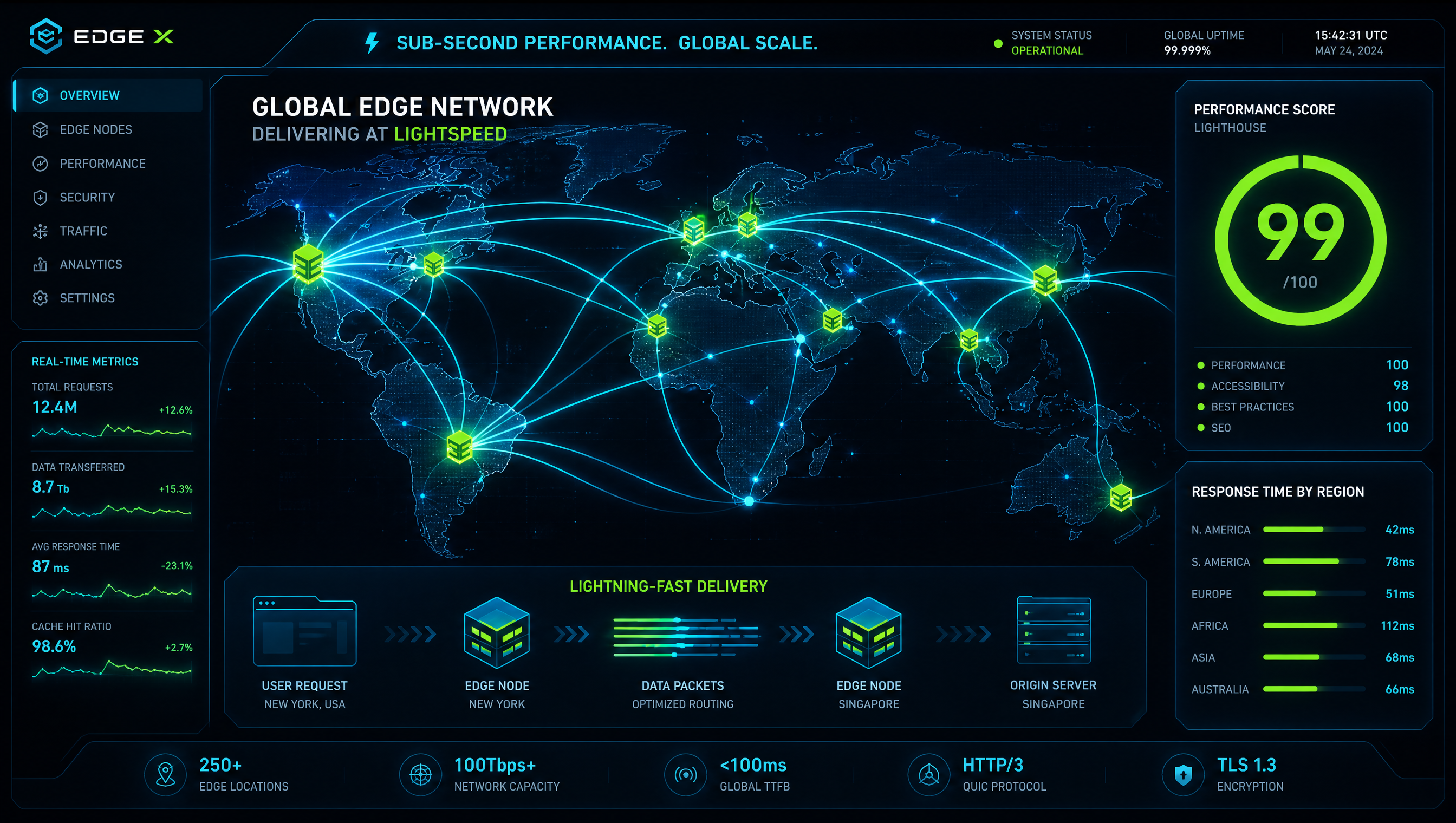
Table of ContentsExpand
Sub-second web performance and 95+ Core Web Vitals do not depend on a specific programming language; they depend on adherence to four universal architectural laws: (1) minimizing Time to First Byte (TTFB < 100ms) via edge caching and stale-while-revalidate reverse proxies (Cloudflare/Fastly), (2) eliminating main-thread blocking by deferring non-critical scripts to maintain Interaction to Next Paint (INP < 150ms) and Largest Contentful Paint (LCP < 1.2s), (3) enforcing strict HTTP Content Security Policy (CSP) headers at the edge proxy, and (4) embedding verified JSON-LD schema and root llms.txt manifests so the site is instantly indexable by Google crawlers and AI answer engines.
- 01.TTFB is determined by edge proximity, not server CPU: cache static and semi-dynamic HTML at edge CDN PoPs close to the user.
- 02.Eliminate render-blocking CSS and JavaScript: inline critical path stylesheets and defer all third-party telemetry.
- 03.Compress images aggressively using modern AVIF/WebP formats with explicit width/height attributes to eliminate Cumulative Layout Shift (CLS = 0).
- 04.Harden your web surface with strict security headers: Content-Security-Policy, HSTS, X-Content-Type-Options, and Referrer-Policy.
- 05.Implement Answer Engine Optimization (AEO): structure your content with JSON-LD TechArticle schemas and llms.txt for dual Google + AI crawler indexing.
| Architectural Vector | Conventional Bloated Website | HarLyn Sub-Second Standard |
|---|---|---|
| Time to First Byte (TTFB) | 800ms - 2500ms (origin database queries on every hit) | <100ms (stale-while-revalidate edge cache at local PoP) |
| Core Web Vitals Score | Fails mobile assessment (INP > 400ms, LCP > 4.5s) | 95+ across all mobile and desktop devices (LCP < 1.2s) |
| Content Security Policy | Missing or permissive 'unsafe-inline' allowing XSS | Strict nonces with zero inline script leakage |
| AI & Crawler Legibility | Unstructured DOM; AI search engines hallucinate company facts | Verified Schema.org JSON-LD and root llms.txt manifest |
Why Frameworks Don't Guarantee Speed
The technology industry loves debating frameworks: *Next.js vs Remix*, *Laravel vs Django*, *Go vs Node.js*.
However, in production, the user's browser does not care which backend framework rendered the HTML. The laws of network physics, mobile CPU thermal throttling, and browser DOM rendering engines remain completely unchanged:
- A packet sent from a server in London or Virginia to a mobile device in Nairobi takes 180ms to 280ms of round-trip latency purely due to the speed of light through fiber cables.
- If your server executes heavy database queries before emitting the first byte, your Time to First Byte (TTFB) exceeds 1,200ms before rendering even begins.
- If your frontend loads 2MB of uncompressed JavaScript and third-party tracking scripts, the mobile processor freezes, failing Google's Interaction to Next Paint (INP) threshold.
Here is the stack-agnostic architectural blueprint we use at HarLyn to deliver sub-second websites that achieve 95+ Core Web Vitals across any programming language.
Principle 01: Sub-100ms TTFB via Edge Caching
Your origin server should never render the same public page twice.
Whether your application is powered by Python, PHP, Go, C#, or Node.js, place an Edge Caching Reverse Proxy (such as Cloudflare, Fastly, or Vercel Edge Network) in front of your service.
Stale-While-Revalidate HTTP Header Pattern
Emit strict caching headers from your application routes:
HTTP/1.1 200 OK
Content-Type: text/html; charset=UTF-8
Cache-Control: public, max-age=60, s-maxage=3600, stale-while-revalidate=86400
CDN-Cache-Control: max-age=3600- `s-maxage=3600`: Edge servers cache the compiled HTML for 1 hour. Subsequent visitors receive responses directly from the nearest regional point of presence (PoP) in under 50 milliseconds.
- `stale-while-revalidate=86400`: If the cache expires, the edge immediately serves the cached copy while revalidating with your origin server asynchronously in the background.
Principle 02: Critical Rendering Path & Zero-CLS
To achieve Largest Contentful Paint (LCP) under 1.2 seconds:
- Inline Critical Path CSS: Embed the essential styling for above-the-fold elements directly into the HTML
<head>. Load secondary stylesheets asynchronously. - Explicit Image Dimensions: Every
<img>tag must specify explicitwidthandheightattributes or CSSaspect-ratio. This reserves layout geometry before the image downloads, driving Cumulative Layout Shift (CLS) down to zero. - Modern Formats: Convert hero imagery to WebP or AVIF at 85% compression quality, reducing payload size by over 60% compared to legacy PNGs.
<!-- Zero-CLS, High-Speed Image Implementation -->
<picture>
  <source srcset="/hero.avif" type="image/avif">
  <source srcset="/hero.webp" type="image/webp">
  <img
    src="/hero.jpg"
    alt="High Performance Architecture Diagram"
    width="1200"
    height="630"
    loading="eager"
    fetchpriority="high"
    style="aspect-ratio: 16/9; width: 100%; height: auto;"
  />
</picture>
Principle 03: Zero-Trust Security Headers & CSP
A fast website that is vulnerable to cross-site scripting (XSS) or clickjacking is a failure of engineering.
Configure strict HTTP response headers across your web server (Nginx, Caddy, Apache, or Cloudflare Worker):
# Security Headers Configuration
add_header X-Frame-Options "DENY" always;
add_header X-Content-Type-Options "nosniff" always;
add_header Referrer-Policy "strict-origin-when-cross-origin" always;
add_header Permissions-Policy "camera=(), microphone=(), geolocation=()" always;
add_header Strict-Transport-Security "max-age=63072000; includeSubDomains; preload" always;
add_header Content-Security-Policy "default-src 'self'; script-src 'self' 'nonce-{RANDOM}'; style-src 'self' 'unsafe-inline'; img-src 'self' data: https:; font-src 'self' data:; connect-src 'self' https://api.harlyndigitalpartners.co.ke;" always;
Principle 04: Machine-Legible Technical SEO & AEO
Traditional SEO optimized only for Google's indexer. Modern search requires optimizing for AI Answer Engines (ChatGPT, Perplexity, Gemini, Claude).
- JSON-LD Structured Data: Inject semantic
TechArticleandOrganizationschemas on every page so machines parse facts without regex parsing. - Root `llms.txt` Manifest: Host a clean, factual markdown manifest at
/llms.txtdetailing your company's core services, architecture standards, and key case studies. - Answer-Shaped DOM: Place direct answers and thesis summaries in the opening section of every technical article, allowing language models to cite your expertise verbatim.
Case Evidence: Munar Kenya 0.6s Speed
This architecture was implemented for Munar Kenya (munar-ke.vercel.app), an e-commerce platform serving Kenyan consumers. By eliminating bloated JavaScript runtimes and enforcing edge-cached rendering:
- Time to First Byte (TTFB): 65ms
- Full Page Load Speed: 0.6s
- Google Lighthouse Score: 99 / 100
The HarLyn Standard
We engineer web systems that dominate search rankings, convert visitors instantly, and withstand malicious threats across any technology stack.
Frequently Asked Questions
Bring This Resilience to Your Enterprise Stack
Harrison Ndeke and Nazline Mwita conduct a comprehensive 48-hour diagnostic audit of your n8n workflows, Next.js web application speed, and cybersecurity perimeter.